Nuclear spacecraft propulsion gets major upgrade
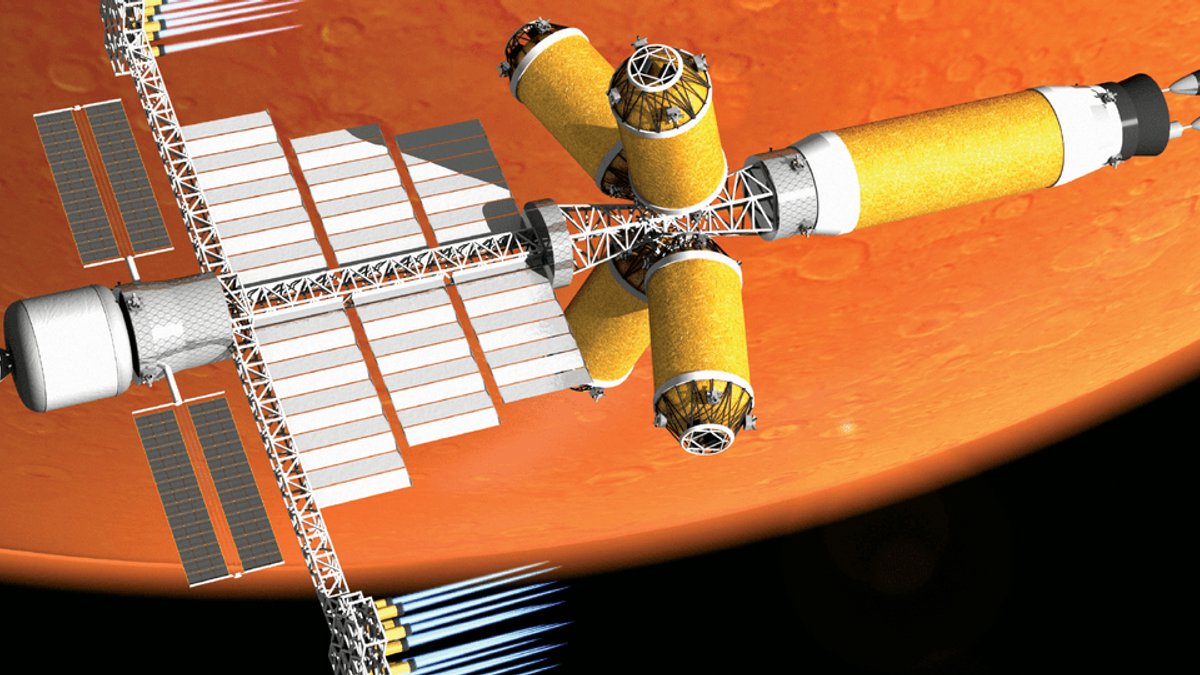
NASA has revealed a new spacecraft propulsion design that could reduce travel time to Mars. The system combines nuclear thermal and nuclear electric propulsion to achieve this goal.
The approach, called bimodal nuclear propulsion, merges two existing technologies to improve efficiency without requiring new fuel or reactor advancements. Unlike chemical rockets that rely on combustion, this method uses heat from a reactor to accelerate propellant—usually hydrogen—at much higher speeds.
How the design works
The bimodal system divides propulsion into two phases. In the initial nuclear thermal propulsion (NTP) stage, hydrogen is heated by a fission reactor and expelled through a nozzle, producing thrust similar to a conventional rocket but with about twice the efficiency. Once the spacecraft reaches higher speeds, it shifts to nuclear electric propulsion (NEP), where the reactor powers an electric thruster that ionizes propellant and accelerates it using magnetic fields.
NEP consumes less fuel than NTP but generates weaker thrust. By combining both, NASA intends to use NTP’s power for quick acceleration and NEP’s efficiency for sustained travel.
Related: Student researchers gain spotlight at IEEE conference
Teams at NASA have been developing the concept under the Space Nuclear Propulsion program. A major challenge has been integrating the two systems without adding too much weight or complexity. The current design uses a single reactor for both modes, switching between them through a heat exchanger and power conversion system.
Renewed interest in nuclear propulsion
Nuclear propulsion is not a new idea. The U.S. tested nuclear thermal rockets in the 1960s under the NERVA program, but budget cuts and changing priorities halted progress before it could be used in space. Recent improvements in materials science and reactor safety have reignited interest, particularly as NASA and private companies plan longer missions to Mars.
Chemical rockets, while dependable, are constrained by their fuel’s energy density. Even advanced systems like SpaceX’s Starship would face difficulties sustaining a crewed Mars mission without large fuel depots or multiple launches. Nuclear propulsion offers a more compact and powerful solution. A spacecraft using this method could carry less fuel while still reaching Mars faster, reducing astronauts’ exposure to deep-space radiation and the mental strain of long flights.
Safety remains a key concern. Nuclear reactors in space must operate in extreme conditions, and any malfunction could disperse radioactive material. NASA’s design includes backup cooling systems and shielding to protect the crew and reactor. The agency has stated the reactor would only activate once the spacecraft reaches a stable orbit, far from Earth’s atmosphere.
No certainty exists that the design will perform as expected. Earlier nuclear propulsion projects encountered delays, cost overruns, and technical issues. However, with Mars missions becoming a priority, the need for a faster, more efficient propulsion system is increasing. Even partial success could change how humans and machines travel through the solar system.
Related: Quantum computing could ease AI’s power demands
For now, the focus remains on validating the concept. Engineers are running simulations to study how the two propulsion modes interact and how the spacecraft’s structure will handle thermal and mechanical stresses. One unexpected obstacle has been the hydrogen storage system, which must keep the propellant at cryogenic temperatures for months without significant loss. New insulation materials and active cooling methods are being tested to solve this problem.
The schedule is demanding. Initial funding has been secured through the Artemis program, but future budgets will depend on congressional approval and public interest in space exploration.
Even if the bimodal design doesn’t become the standard for Mars missions, the research could lead to other useful technologies. Nuclear electric propulsion, for instance, is already being considered for deep-space probes and lunar landers. The knowledge gained from integrating these systems might also help develop future hybrid propulsion designs, whether nuclear or otherwise.
Old assumptions about space travel are being reconsidered. Chemical rockets have served well for decades, but they may not be sufficient for the next phase of exploration. Nuclear propulsion, in some form, will likely play a role, and the bimodal design could be the first step toward making it practical.

Student researchers gain spotlight at IEEE conference


