Solar eclipse sparks science with jets and balloons
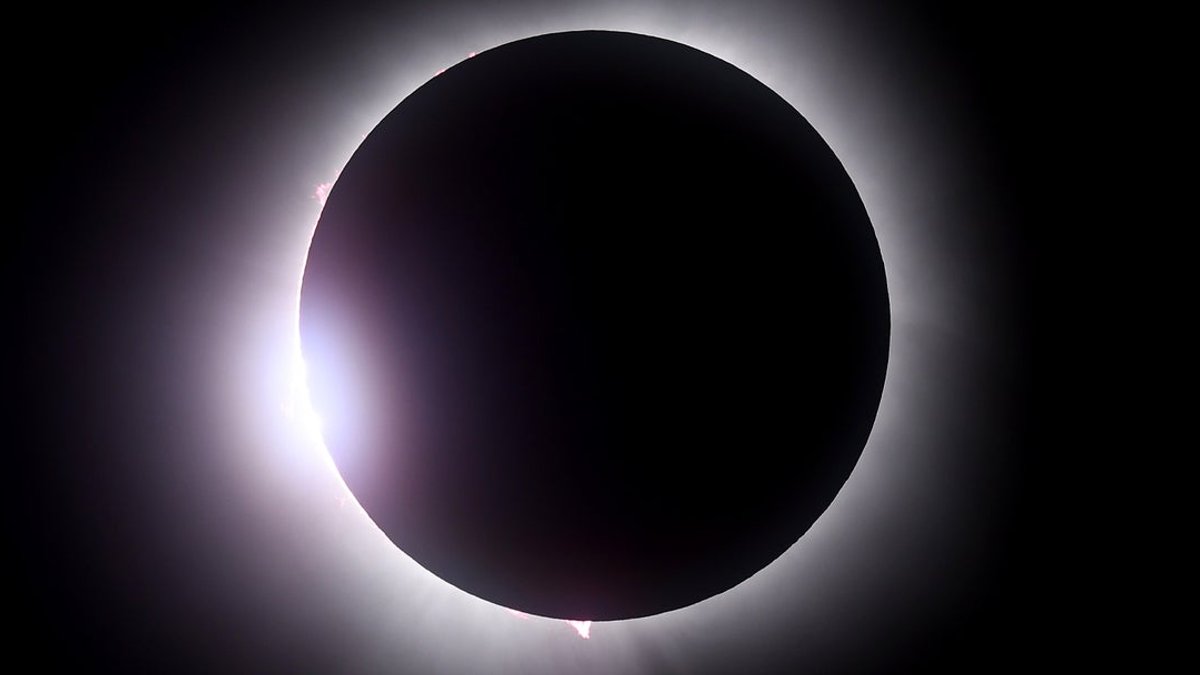
On August 12, the sky will go dark for just two minutes and 18 seconds at its longest across a swath of the world that includes Greenland, Iceland and northern Spain — and scientists everywhere will be scrambling to gather as much data as they possibly can. Total solar eclipses offer rare, brief opportunities to learn about everything from the physics of the sun to animal behavior and atmospheric movements.
The one in August will be no different.
Some planned experiments aim to gather heliophysics data, measure radiation entering Earth’s atmosphere, monitor gravity waves and even re-create a famous test of Albert Einstein’s general theory of relativity. Given how short the totality will be, there won’t be a second to waste.
Related: Northeast braces for hazardous wildfire smoke
NASA jets chase the sun’s corona at 470 miles per hour
NASA will have three WB-57 high-altitude research planes in the air over Iceland. The jets reach speeds of around 470 miles per hour — not fast enough to keep pace with the event, but enough to let the agency gather data on the star’s corona using cameras that will capture images in visible, near-infrared and mid-infrared wavelengths.
The planes will be well above cloud level at 50,000 feet.
This puts them in a prime position to pick up these wavelengths without interference from most of the atmosphere’s water vapor, says Amir Caspi, a solar physicist at the Southwest Research Institute who is working with NASA on the project.
Related: Know In Detail About SIEM (Security Information And Event Management)
“It’s a rare opportunity to be able to see and measure the sun’s outer atmosphere, the solar corona,” Caspi said. “The surface of the sun, the disk of the sun, is a million times brighter than the solar corona, at least in visible wavelengths. If you want to study and measure the solar corona, an eclipse gives you that opportunity by blocking out something that’s a billion times brighter.”
The jets will be joined in the sky by many balloons, including some from the Nationwide Eclipse Ballooning Project. That initiative, made up of student groups from across the U.S., will deploy 80 balloons over Spain and Iceland during 30 hours. Some balloons will carry engineering experiments aimed at pushing the boundaries of what cheap systems and balloons can do, says Angela Des Jardins, the project’s lead and an associate research professor at Montana State University.
Balloons hunt gravity waves
Des Jardins is looking for atmospheric gravity waves — ripples of rising and sinking air that can cause undulating cloud patterns and turbulence. Such waves can also signal extreme weather.
Related: Experts Explain Buckling Steel Beams in Manhattan Skyscraper
“Gravity waves happen all the time, from temperature changes of day and night or when storms come in, you have those kinds of pressure changes that make gravity waves,” Des Jardins said. “They even come from physical disturbances like mountain ranges, but it’s been theorized since the 1970s that the cold, dark shadow of an eclipse would make special, specific gravity waves that could travel really high in elevation, up into the stratosphere.”
She ran a similar experiment during the 2024 total eclipse visible across parts of North America. That time, the researcher found evidence that these high-altitude gravity waves do occur. Now Des Jardins hopes to determine when and where those disturbances originate in the troposphere. Such results could help develop better climate models and a better understanding of how pollution affects the world we live in, she added.

Northeast braces for hazardous wildfire smoke


