Dead Frogs Powered First Battery
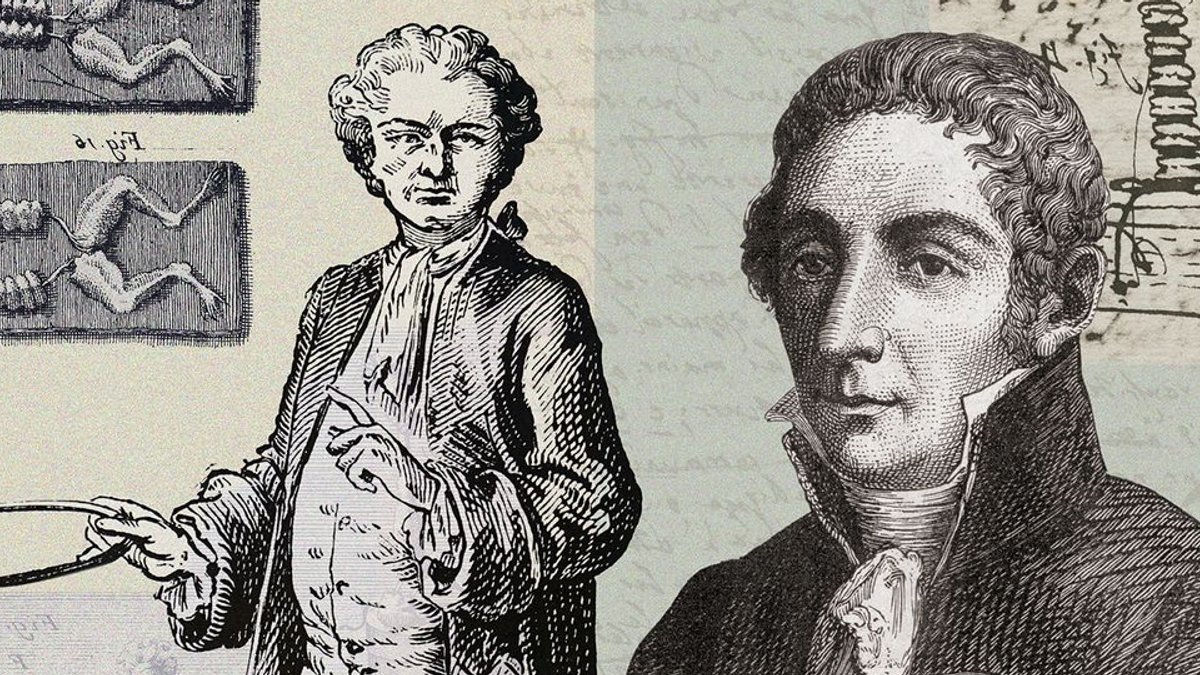
In 1791, Italian physicist Luigi Galvani noticed something peculiar while dissecting a dead frog in his laboratory. When he touched the creature’s legs with metal instruments, they twitched. Galvani believed the phenomenon came from within the animal itself, a kind of “animal electricity.” His colleague Alessandro Volta thought otherwise, and that disagreement would spark one of the most significant inventions in the history of science.
The Frog Experiment That Changed Everything
Galvani’s observation spread quickly through European scientific circles. He published his findings and demonstrated the effect publicly, using brass hooks and iron rails to make dead frogs’ legs kick in sequence. The experiments captured the imagination of scientists who saw in them proof of a new form of electricity distinct from the static charges produced by early machines.
Volta, a professor of experimental physics at the University of Pavia, grew skeptical. He repeated the experiments and became convinced the twitching came not from the frog but from the metals touching each other. The animal tissue simply conducted the current. In 1800, he set out to prove his theory by creating the first device to produce a steady electric current.
Related: Spain Nuclear Power Extension Stabilizes Fragile Grid
Building the First True Battery
Volta stacked pairs of copper and zinc discs separated by cloth soaked in saltwater. When he connected the top and bottom discs with a wire, current flowed. He called his invention the “electric organ” because it mimicked the electric organs found in certain fish like the torpedo ray. Today, we call it the voltaic pile, and it marks the birth of the battery.
The pile produced a continuous flow of electricity that could be maintained indefinitely, unlike the momentary discharges from Leyden jars or electrostatic machines. Scientists could now study the effects of steady current for the first time.
Within weeks, researchers were using the pile to decompose water into hydrogen and oxygen. That breakthrough alone transformed chemistry and led to the identification of several new elements. The pile’s influence spread rapidly across laboratories in England, France, and Germany.
Related: Security leaders dig deeper at Black Hat 2026
Legacy of an Accidental Discovery
Volta’s invention built directly on Galvani’s work, even as it contradicted Galvani’s interpretation. The two scientists maintained a friendly rivalry, and Volta acknowledged his debt to the earlier researcher by naming the unit of electrical potential the “volt.” Napoleon awarded him the Legion of Honour and made him a count for his contributions to science.
The basic principle behind the voltaic pile remains in use today. Modern batteries, from the ones in flashlights to those powering electric vehicles, rely on the same fundamental concept: two different metals separated by an electrolyte solution that conducts ions. The dead frog that started it all sits somewhere in the background of every battery ever made.

Spain Nuclear Power Extension Stabilizes Fragile Grid


